
When a business needs junk gone, the first question is usually simple: how much will this cost? The answer depends on several commercial junk removal pricing factors, and the biggest mistake is assuming every job is priced the same way. An office cleanout, a retail fixture removal, and a warehouse debris pickup may all involve “junk,” but they do not create the same labor, loading time, disposal costs, or scheduling demands.
For property managers, business owners, and facility teams, clear pricing matters because downtime costs money. You need a crew that can show up on time, work efficiently, and give you a straightforward quote based on the real scope of the job – not a vague estimate that changes later for avoidable reasons.
What actually drives commercial junk removal pricing factors
Most commercial junk removal jobs are priced around a combination of volume, labor, material type, and access. That means two jobs that fill the same amount of truck space can still have different totals if one takes twice as long to load or includes harder-to-dispose materials.
In practice, pricing is rarely about one single number. It is about the full removal picture. How much has to go, where it is located, how heavy it is, whether anything needs dismantling, and what disposal method is required all affect the final quote.
Volume is often the starting point
For many commercial jobs, the amount of space your items take up in the truck is the first pricing benchmark. A few desks and chairs from a small office suite will not cost the same as clearing shelving, displays, and backroom stock from a retail location.
Volume-based pricing is straightforward because it reflects hauling capacity. Larger loads require more truck space and usually more disposal handling. That said, volume alone never tells the whole story. Light but bulky items can be easier and faster to remove than dense materials packed into a smaller area.
Labor can change the quote quickly
Labor is one of the most important commercial junk removal pricing factors, especially for businesses. If the crew can back up near a ground-floor loading area and remove items in a clean path, the labor portion stays more efficient. If they are dealing with elevators, stairwells, long interior walks, tight hallways, or occupied spaces that require extra care, the job takes longer.
This is why an office on the third floor may cost more than a larger ground-level space. The work is slower, the handling is more complex, and the crew has to protect walls, floors, door frames, and common areas during removal.
Type of junk matters more than many businesses expect
Not all commercial debris is equal. Standard office furniture, cubicles, boxed miscellaeous items, and general non-hazardous junk are usually simpler to price than specialized or heavy materials.
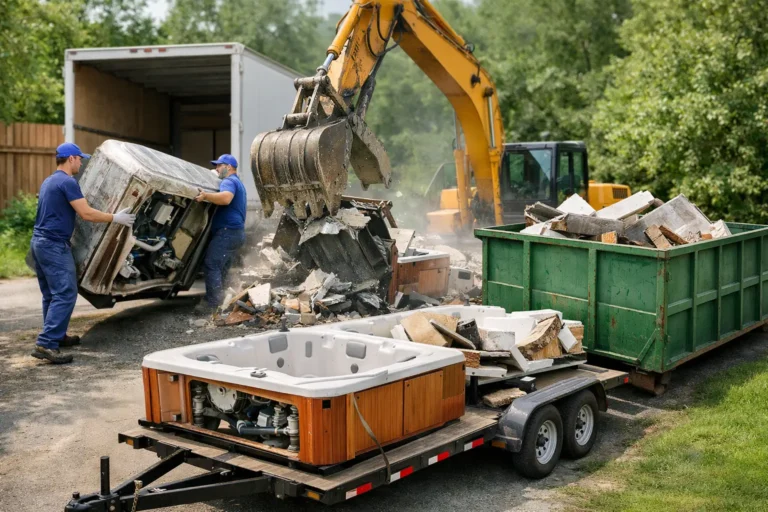
Construction debris is a good example. Drywall, tile, lumber, fixtures, and demolition waste are denser than typical office contents and can increase both labor and disposal costs. The same is true for restaurant equipment, commercial appliances, shelving systems, or water-damaged materials. Heavy loads stress time, truck capacity, and dump fees differently than lighter cleanout items.
Disposal fees vary by material
Disposal costs are not fixed across every load. Some materials are cheaper to process, while others come with higher landfill or transfer station fees. Recycling and donation can help in certain cases, but only if items are in suitable condition and accepted locally.
That creates one of the biggest pricing variables for commercial customers. A load of reusable office furniture may be more manageable than a load of broken particleboard desks, soaked carpet, and mixed renovation debris. The crew still has to sort, load, transport, and dispose of it all, but the downstream cost structure changes.
Special handling can add time and equipment needs
Some commercial jobs involve items that are awkward, oversized, or require partial disassembly before removal. Large conference tables, built-in counters, metal racking, copiers, and old equipment often take more than basic lifting and hauling.
If your removal includes light demolition, pricing will usually reflect that added scope. Taking apart a retail checkout counter, removing storage structures, or hauling debris after an interior tear-out is different from simply loading loose junk. It calls for more labor, more tools, and more cleanup.
Access conditions affect speed and cost
Access is one of the most overlooked commercial junk removal pricing factors. Businesses often focus on what needs to go, but the removal team also has to consider how they will get it out.
A few details can change the quote significantly. Is there a loading dock? Is parking nearby, or does the truck have to stage far from the entrance? Are there time restrictions from property management? Does the crew need to work around customers, tenants, or staff during business hours?
These conditions matter because commercial hauling is time-sensitive. If a team spends extra time navigating access limitations, waiting on freight elevators, or coordinating around building rules, labor costs rise even when the junk volume stays the same.
Occupied spaces require more care
Businesses often need removals completed without disrupting day-to-day operations. That is completely reasonable, but it can make the work more delicate. A crew may need to remove items in stages, use quieter methods, or avoid certain hours to respect employees, tenants, or customers.
That type of controlled removal is often worth it because it reduces operational disruption. Still, it can affect pricing compared with an empty-space cleanout where the crew can move continuously and finish faster.
Scheduling urgency can influence commercial pricing
If your business needs same-day or next-day service, pricing may reflect the urgency, especially during peak scheduling periods. Fast response is valuable when you are preparing for a move, clearing a foreclosed property, resetting a retail space, or turning over a commercial unit for a new tenant.
Urgent service is not always dramatically higher, but it depends on crew availability, truck routing, and the complexity of the job. A simple pickup may be easy to fit in. A full commercial cleanout with labor-heavy removal and disposal sorting requires more planning.
For that reason, early communication usually helps you control costs. The more accurately you describe the job, the easier it is to schedule the right crew and avoid last-minute surprises.
On-site quotes are often the fairest option
Commercial jobs are one area where on-site quotes make a lot of sense. Photos can help, but they do not always show stair access, load distance, item density, or the condition of materials. What looks like a quarter-truck of debris in a picture may involve much more labor once the crew arrives.
An on-site quote gives everyone a clearer starting point. You know what is included. The hauling team can assess labor, volume, and disposal needs properly. That keeps pricing more transparent and reduces the chance of misunderstandings.
For businesses that value speed and predictability, that matters. Local Loop Junk Troop approaches quotes the way commercial customers prefer – based on the real job conditions, with upfront pricing and no need for you to guess what counts and what does not.
How to keep your commercial junk removal quote efficient
If you want the best value, the goal is not just finding the lowest number. It is making the job easier to complete. Grouping items in one area, identifying exactly what stays and what goes, and sharing access details before the appointment can all help keep labor time under control.
It also helps to mention anything unusual in advance. If there are oversized desks, palletized materials, demolition debris, restricted loading hours, or multiple suites involved, say so early. Clear information leads to a more accurate quote.
If your property has elevators, loading dock procedures, COI requirements, or after-hours rules, bring those up before scheduling. Those details are normal in commercial work, but they affect crew planning.
Why transparent pricing matters for businesses
Business owners and property managers are not just paying to have items hauled away. They are paying for labor, speed, professionalism, property protection, and proper disposal. The cheapest number on paper is not always the best value if the crew shows up unprepared, damages common areas, or leaves part of the mess behind.
Good commercial junk removal pricing should feel clear, not complicated. You should understand what is driving the cost and what conditions could change it. When a company explains that pricing is based on volume, labor, access, debris type, and disposal requirements, that is not a sales tactic. That is simply how professional hauling works.
If you are comparing quotes, look beyond the total. Ask whether loading is included, whether cleanup is part of the service, whether special items change the rate, and whether the quote reflects the actual access conditions at your property. A fair quote is one that matches the job as it really exists.
The best cleanup projects are the ones that move fast, stay organized, and do not create extra work for your team. When you understand the pricing factors ahead of time, it becomes much easier to schedule service confidently and get your space back to business.